Georgia Tech · RL2 · Sep 2026 – present
What Makes Retargeted Demonstrations Learnable?
The same human demonstrations, retargeted two ways, train policies with very different success. Which properties of the retargeted actions explain it?
- Ongoing
- Real robot + simulation
- Imitation learning
- Humanoid
The question
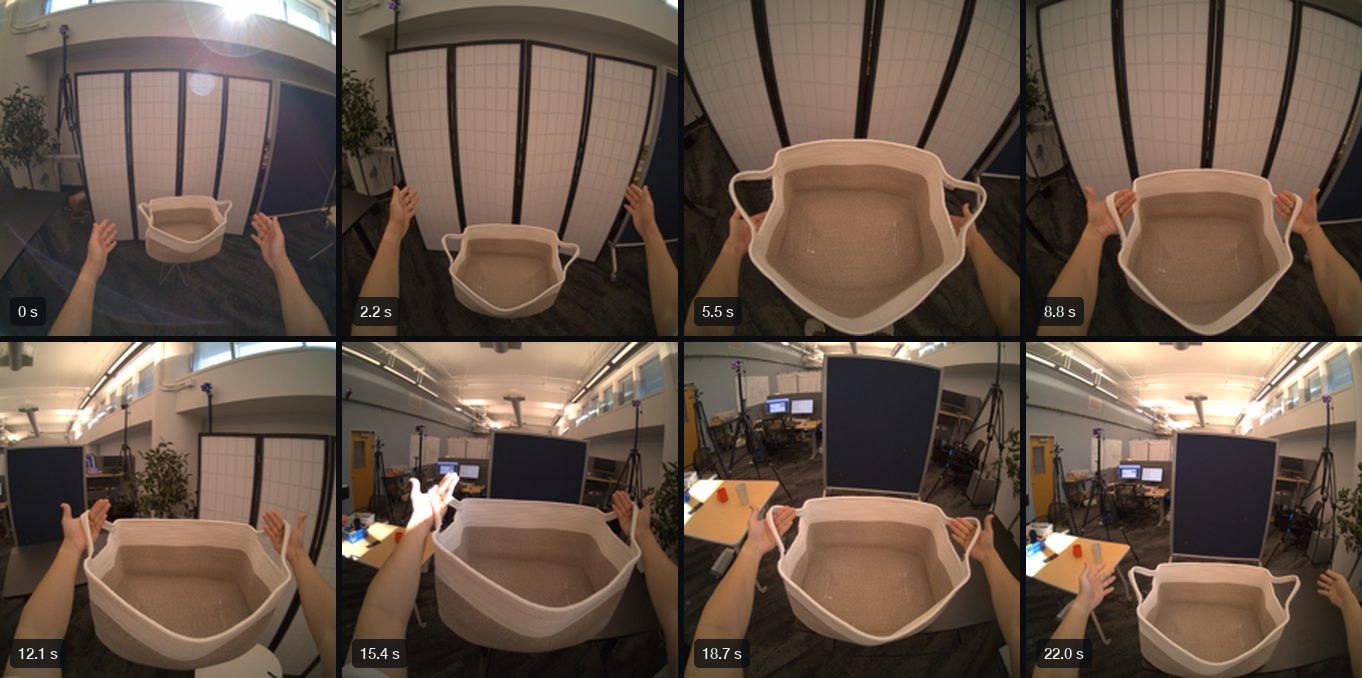
Retargeting maps human motion onto a robot. In a follow-up to WARP, two retargeters applied to the same source demonstrations produced policies with very different success (14% vs 37% on a coffee-making task in simulation, each in its own scene layout). I study which properties of the resulting action data — consistency, smoothness, diversity, and how predictable actions are from observations — make demonstrations easier to learn by imitation.
What I did
- Recorded egocentric human demonstrations with Aria glasses (45 of the 98 demos of a two-handed basket carry), which the WARP pipeline retargets to the Rainbow RBY1 humanoid, and ran the real-robot policy rollouts.
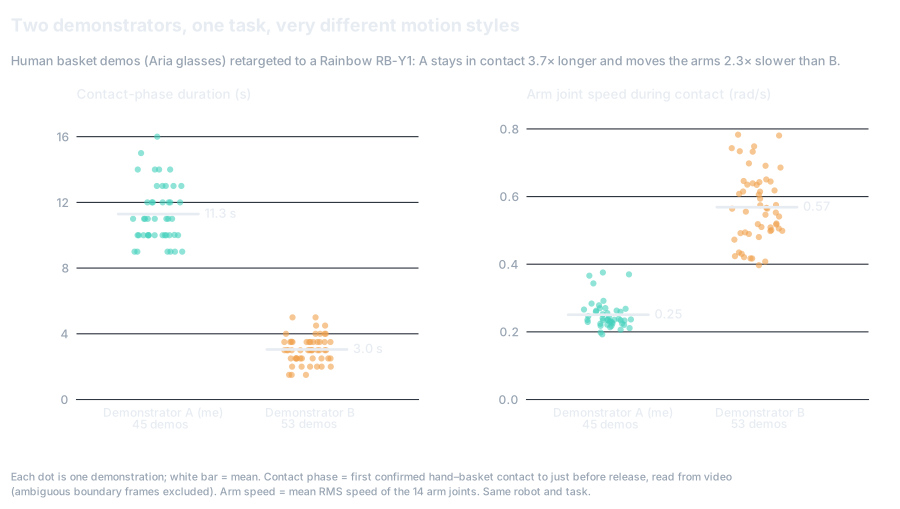
- Characterized how a demonstrator's style survives retargeting: the two demonstrators' motions differ clearly in speed and timing.
- Designed a controlled simulation study on the RBY1 (DexMimicGen coffee task): 7 training-data conditions, 14 policies, 1,400 closed-loop rollouts, testing whether data-quality metrics from the literature — action variance, state–action mutual information, spectral arc length, and signature-kernel diversity — explain the gap.
Findings so far
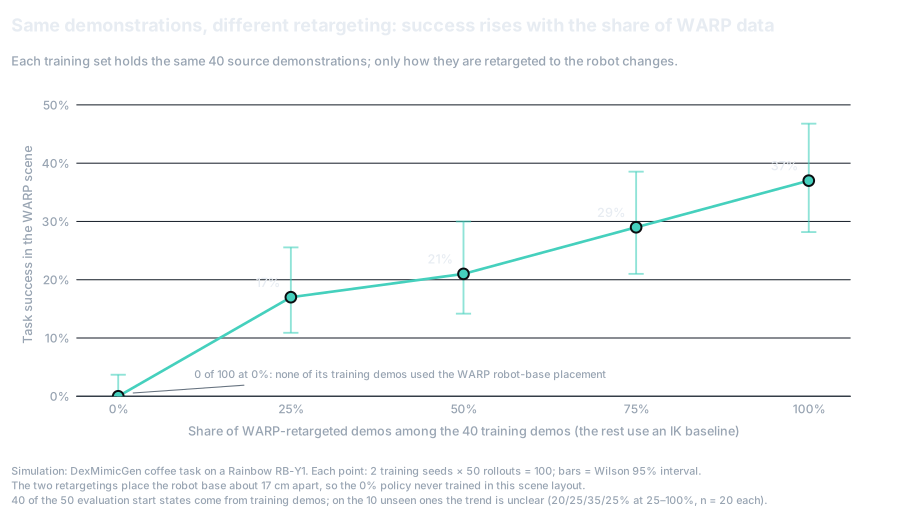
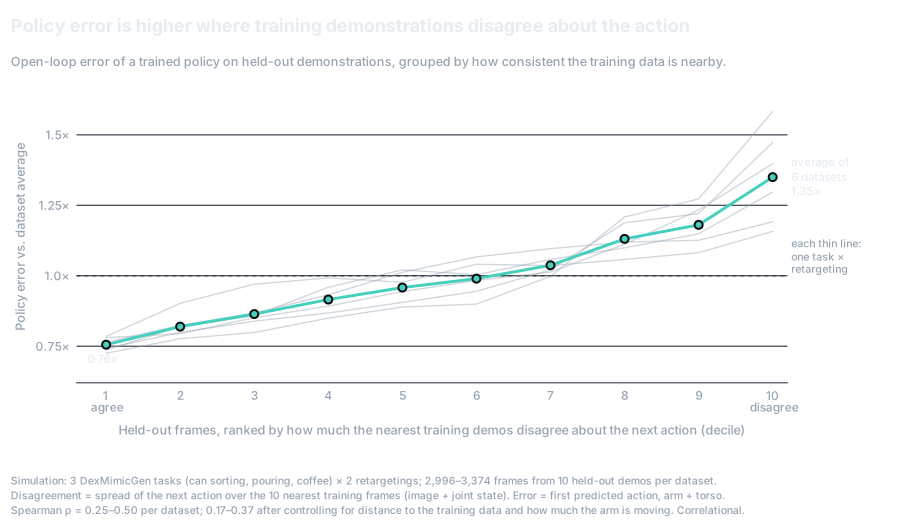
In the WARP scene, success rises with the share of WARP-retargeted data — though the two retargetings also place the robot base about 17 cm apart, so scene layout and data are not yet separated. None of the dataset-level metrics tracks success consistently across tasks. Looking frame by frame is more telling: a policy errs more exactly where its nearest training demonstrations disagree about what to do next.
Credits
- Advisor: Prof. Danfei Xu.
- Part of the WARP project in RL2, led by Chuye Zhang (WARP: arXiv 2606.29940).
- DexMimicGen retargeted datasets, the baseline policy checkpoints analysed in the local-consistency figure, and the training/rollout code: Zhenyang Chen. I trained the 14 controlled-study policies with that setup and ran the analyses.