Georgia Tech · RL2 · Sep 2026 – present
One Action Interface, Seven Dexterous Hands
Does training on more kinds of robot hands let a policy control a hand it has never seen?
- Ongoing
- Simulation
- Cross-embodiment
- Teleoperation
The question
Dexterous hands differ in size, joint count, and finger layout, so a policy trained on one hand usually cannot drive another. I am studying whether co-training on more hand types improves zero-shot transfer to a hand that was held out of training entirely.
What I built
- A shared action interface — wrist pose plus five palm-frame fingertip positions — and per-hand inverse kinematics that turns it into each hand's joint commands. Fingers a hand does not have are left empty rather than invented. The viewer above runs the same idea live in your browser.
- An Apple Vision Pro → Isaac Sim teleoperation workflow (on NVIDIA Isaac Lab's CloudXR streaming), which I used to collect demonstrations on all seven simulated hands.
- A leave-one-hand-out benchmark over seven hands — Shadow, Inspire RH56, Allegro, LEAP, Sharpa Wave, Wuji, and Wuji 2 — and the experiment platform that schedules and tracks well over a hundred training and evaluation jobs on a Slurm cluster.
Early result
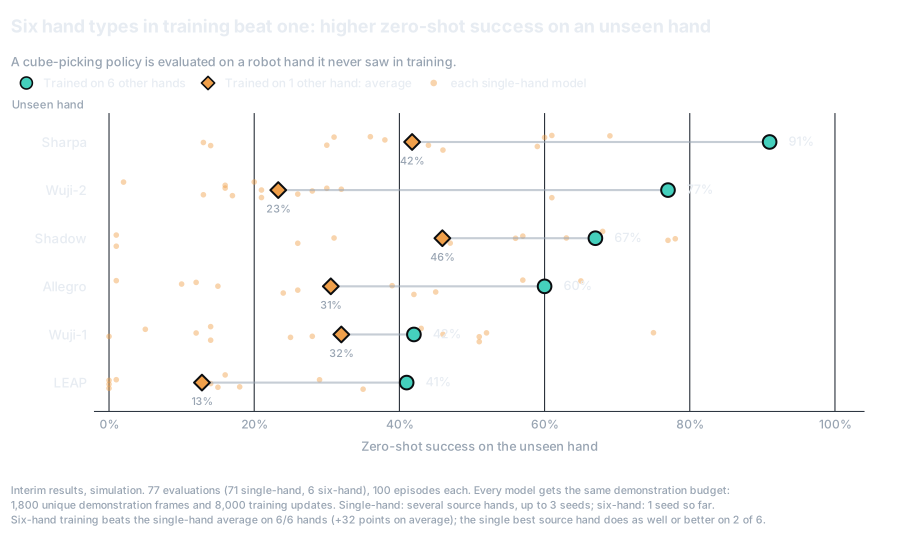
With the same demonstration budget, a policy co-trained on six hands reaches about twice the zero-shot success of single-hand training on the held-out hand, and is higher on every target hand evaluated so far. It does not yet beat the single best source hand; the full curve from one to six training hands is in progress.
Credits
- Advisor: Prof. Danfei Xu.
- Policy: HAT (Human Action Transformer) with its official code.
- Hand models: open-source URDFs from Shadow Robot (BSD-3-Clause), Wonik Robotics/SimLab (BSD-2-Clause), LEAP Hand/CMU (MIT), Sharpa (Apache-2.0), Wuji Technology (MIT) and Inspire Robots (RH56 model via Renesas RDK / dex_urdf). Sources and licenses: /hands/CREDITS.json.
- Simulation: Isaac Sim with DexVerse environments. IK: dex-retargeting.